GitAegis Cloud · Off until you turn it on · Per repository
It explains what happened. It does not get to do anything about it.
Off by default · Enabled per repository · Explanations only: it holds no path to the orchestrator
The artefact you asked about
An operation plan, a journal entry, timeline events, a conflict, a Doctor finding, with the Git metadata it references.
An explanation, with its sources
Each claim shows the event and oids behind it. Anything it proposes becomes an ordinary intent: plan, capsule, preview, your approval, journal.
Never in a request
Whole-repository contents. Files outside the artefact. Capsule contents. Credentials, tokens, SSH keys or keychain contents. Other repositories.
The useful question is never "write me a commit message"
The moments where a Git tool is genuinely hard are specific. A rebase that produced conflicts you do not recognise in a file you have never opened. A journal entry saying an operation stopped halfway. Three unreachable commits with the subject wip and no memory of which is which. A history that has been rewritten and no longer resembles what your colleague described.
Those are reading problems on real state. They are answerable (from the plan, the journal, the timeline, the conflict stages and the diff) and they are tedious.
That is the whole scope. Not autocomplete, not code generation, not a chat window that happens to be near your repository.
Where an explanation comes from
Grounded in the repository, not in a guess
An explanation is produced from state GitAegis has already read. These eight things, and nothing it went looking for on its own.
The operation plan
And the preconditions it has to satisfy.
The journal entry
With its commands and their exit codes.
Flight Recorder events
The ones around the moment in question.
Refs and their oids
Before and after, so a move is a fact.
The three conflict stages
Base, ours and theirs, read from the index.
The diff
Only for the request that needs it.
Commit metadata
Subjects, authors, dates, parents.
Doctor findings
With the evidence behind each one.
Each claim carries its source.
An explanation saying a rebase dropped a commit shows the event and the oids supporting it, and you can open that evidence next to the sentence. A claim without a source is not made.
It does not invent oids, paths, branch names or commands.
Identifiers are real ones, set in mono, linking to the object they name. A proposed command is one the orchestrator can actually plan.
It says when it does not know.
“The timeline shows this ref moved externally at 14:07 and Git recorded no reason for it” is the correct answer to some questions, and it is the answer you get rather than a plausible one.
What it’s for
Six jobs, six real artefacts
Every job reads something that is already on screen in the shipping desktop app. The captures below are those artefacts as they exist today. The explanation panel beside them is the part that arrives when a provider is bound.
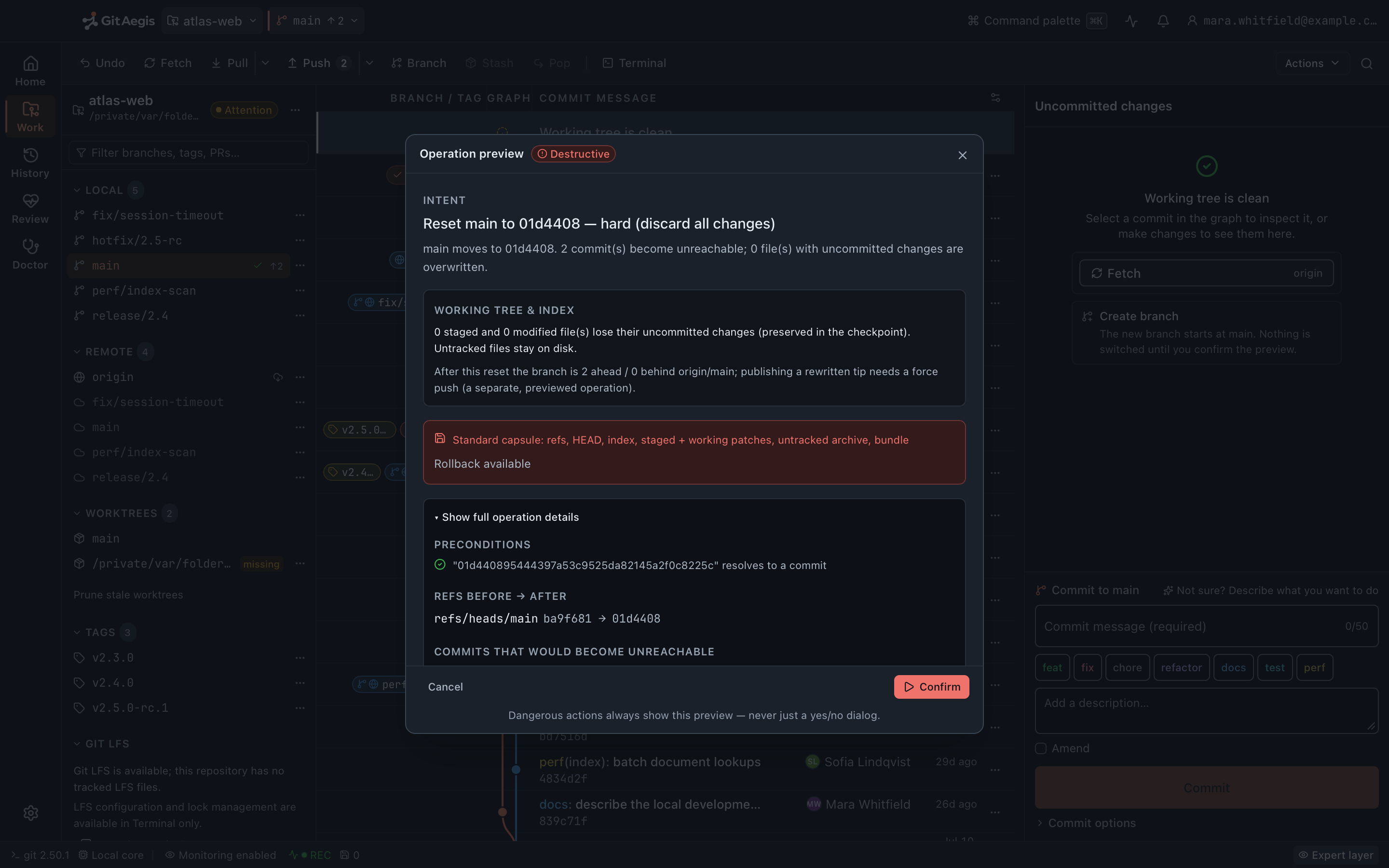
The Operation Preview drawer
Explaining an operation before you approve it.
In the Operation Preview drawer: what the plan will do in plain words, which preconditions matter and why, what the capsule will and will not cover, and what a rollback would restore. The plan is already on screen; this is the reading of it.
The data boundary
Stated as what would be sent, not as a reassurance
This is the specification the feature is built against, and the reason the rest of the page can be short. Read it downwards: what authorises a request, what the request carries and what it never carries, and who receives it.
Nothing is sent until a request is authorised, per repository.
AI assist is off. Turning it on is a decision made on one repository, on the screen that describes what leaving that repository would mean. There is no account-wide switch that enrols new repositories behind you.
What a request carries
The artefact you asked about
sentAn operation plan, a journal entry, a set of timeline events, a Doctor finding, or a Lost Work candidate list.
The Git metadata that artefact references
sentOids, ref and branch names, commit messages, author names and dates, file paths, diffstats.
Diff content, only for the request that needs it
sentA conflict explanation or a commit-message draft. A request that does not need it does not include it, and is labelled accordingly.
The repository's name and the client version
sent
What never crosses
Whole repository contents
neverNothing walks your tree. There is no indexing pass, no embedding, no background sync of code.
Files outside the artefact in the request
neverUntracked files you have not touched, unrelated source, a
.env, not part of any request.Capsule contents
neverIn whole or in part.
Credentials, tokens, SSH keys or keychain contents
neverOther repositories
neverA request about one repository contains one repository.
Who receives it
The request has nowhere to go yet.
GitAegis does not operate a model, and the shipped build has no provider bound to the gateway. The boundary above is the specification a request would be built to. It is not a description of traffic that is flowing today, and describing it as one would be the exact kind of claim this product is supposed to be against.
The rule
AI never executes a mutation. Not once, not with confirmation.
This is the rule the feature is built around, and it has no exception path. There is no agent-mode toggle and no permission that changes it.
No privileged route into your repository
AI assist cannot call the orchestrator, cannot stage, commit, merge, rebase, reset, clean, push or delete, and cannot write to your working tree. What a suggestion can do is become an ordinary intent, and take the ordinary path:
The suggestion becomes a proposed intent.
From here it is indistinguishable from an intent you chose yourself. It is not a privileged request that skips a step.A plan is built.
Intent, risk level, preconditions, and the exact commands that would run.Preconditions are checked, and can veto it.
A held branch lease, a dirty working tree, a missing upstream: the same checks, with the same authority to stop it.The capsule is taken.
If it cannot be written, the operation is refused, including this one. The refusal rule does not have an exemption for an intent that came from an explanation.You approve.
A dangerous plan opens the Operation Preview drawer with the same confirmation gesture as anything else. Nothing runs without your action.The journal records it, and records where it came from.
The entry carries the fact that the intent originated from an AI suggestion, as attribution rather than as a disclaimer.
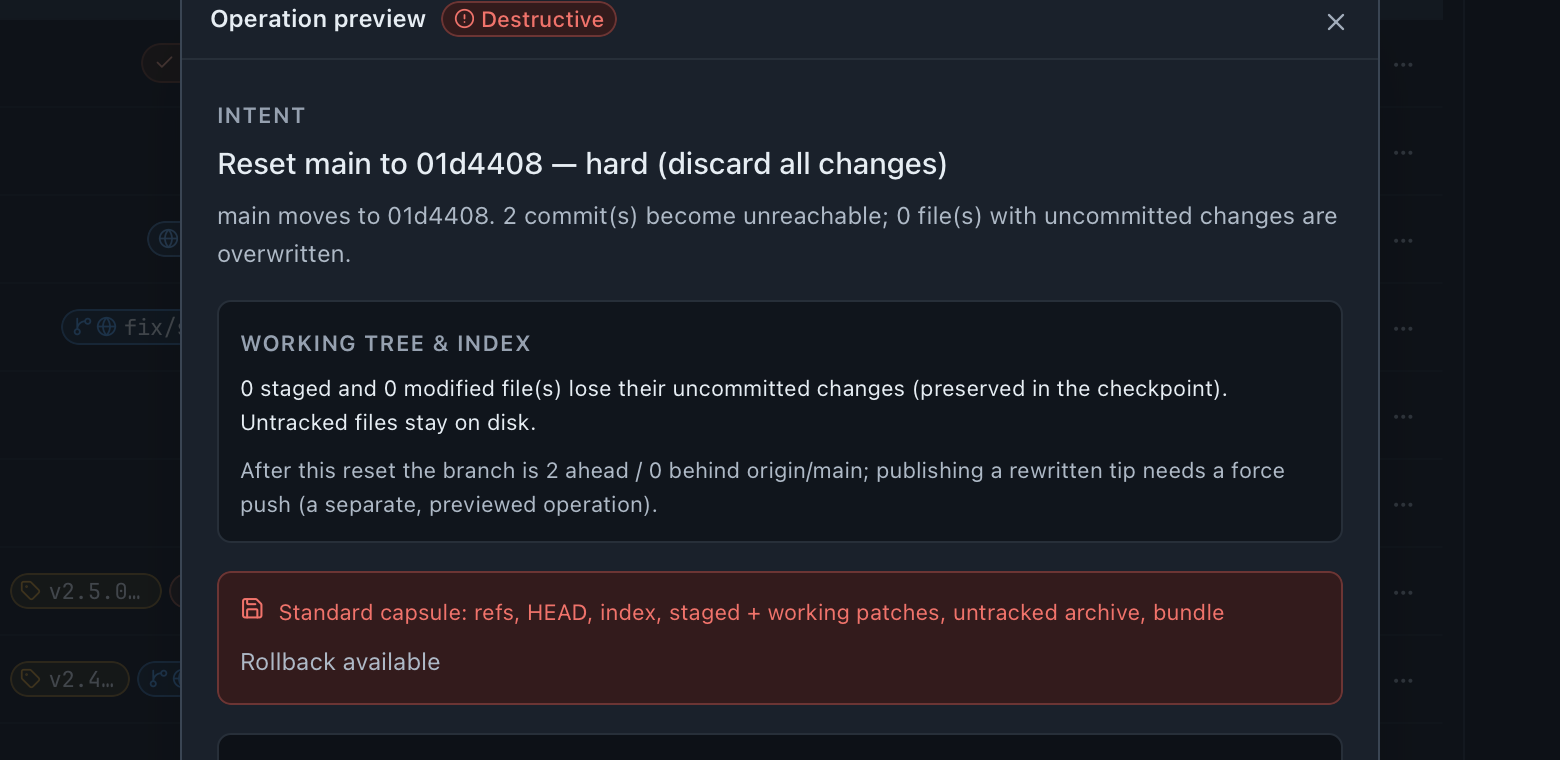
The plan carries a risk level, like any other
The five levels, and what each one takes before it runs, are defined by the operation model, not by where the intent came from.
The reason the rule is absolute
The safety model is the operation model. A second path into the repository (faster, more convenient, slightly less checked) would be a weaker path, and the product’s entire claim would be worth less for having it.
So there is no toggle. Not off by default, not behind a warning, not behind an advanced setting: the code that would let an explanation touch the repository does not exist.
What AI assist does not do
The scope
It does not run anything. No exceptions and no configuration that changes it.
It can be wrong. It is a language model reading real state. Grounding every claim in evidence reduces the failure mode from invention to misreading; it does not remove it. Read the evidence, not only the explanation: particularly before a danger operation. The evidence is on screen next to the explanation for exactly this reason.
It is not a recovery mechanism. Recovery is capsules, the timeline and Lost Work. An explanation is a reading aid: if a capsule was not taken, no amount of explanation returns your work. The recoverability boundary →
It does not index your repository. Which also means it does not know about code you have not asked about. That trade is taken deliberately.
It does not resolve conflicts and does not review your code. Not a security scanner, not a quality gate, not a substitute for a reviewer.
What is not wired up
No provider is bound. GitAegis does not run a model and the shipped build has none configured. There is no provider to name here, and naming one before it is true would make every other sentence on this page worth less.
No retention or training terms to quote. Terms belong to a processor, and there is no processing arrangement to describe. When one exists it will be on the screen that authorises the request, in the DPA and in the privacy policy, and it will say the same thing in all three.
Org policy has no rule for AI assist. The organisation’s policy document pins client settings and carries no rule class for AI scope, request categories or provider configuration. What policy actually controls →
It requires a network and an account. It is a Cloud feature, and it needs an active trial or subscription.
Questions about AI assist
GitAegis Cloud
Your recovery history shouldn't live on one laptop.
Capsule backup, multi-device recovery, shared workspaces, and org policy.
30 days of Pro. No card is taken, so nothing is charged and nothing renews by itself. When it ends, GitAegis keeps opening your repositories: history, undo, capsule restore and export never stop. What waits for a subscription is making new work.
What Cloud adds
Capsule backup
encrypted on your device, uploaded after the operation finishes
Multi-device recovery
restored on a replacement machine with your recovery key
Shared workspaces
Change Sets, sessions, and branch leases
Org policy
signed rules, applied as preconditions